

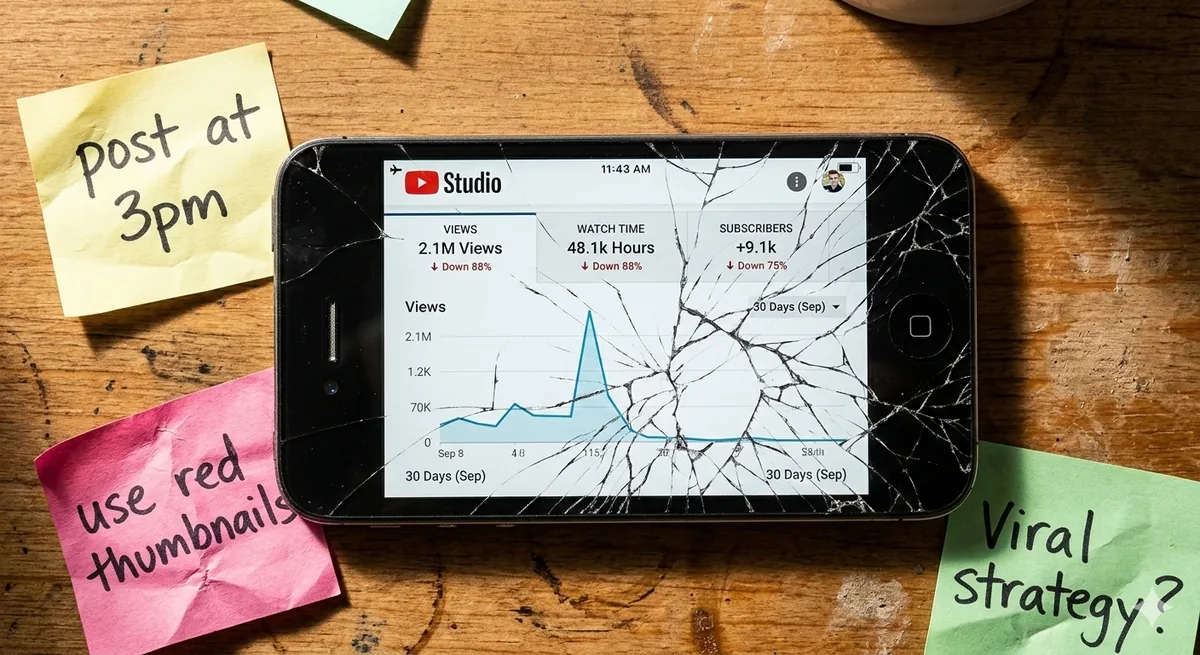
The Death of the "Viral Hack"
Key Takeaways
- 1
Chasing one-off viral moments produces subscriber spikes with no retention — consistent, data-informed publishing beats short-term tricks every time.
- 2
Metrics like VSAT (Viewer Satisfaction score) and hook rate reveal whether your content builds a real audience or just borrows one for 48 hours.
- 3
Long-form content outperforms "hack"-style shorts on sustained engagement, making depth a stronger growth lever than shock value.
- 4
Topic clustering and niche authority compound over time in ways that no single viral moment can replicate.
Why the "Viral Hack" Era Is Over
For years, a certain genre of YouTube advice dominated creator forums: post at the exact right time, use a specific thumbnail color, stuff your title with trending keywords, and watch the algorithm reward you with millions of views overnight. These were the so-called "viral hacks" — shortcuts promising exponential reach without the grind of building a real audience. Creators spent months testing them. Most got nothing. A few got a spike. Almost none got a channel.
The viral hack era is not just fading. It is over. And understanding why it failed is the most useful thing you can do for your channel right now.
What a "Viral Hack" Actually Produces
A viral hack is any tactic designed to game a single distribution signal — a trending sound, a clickbait thumbnail, a manufactured controversy — without a corresponding investment in content quality or audience relationship. The goal is a one-time traffic event, not a subscriber base.
Here is the problem: YouTube's recommendation engine does not reward traffic events. It rewards watch behavior. When a video gets a sudden influx of low-intent viewers — people who clicked out of novelty rather than genuine interest — the watch time collapses, the retention curve drops, and the algorithm interprets the video as a poor match for the audience it reached. The result is a sharp pullback in distribution, often leaving the channel worse off than before the spike.
Hook rate — the percentage of viewers who watch past the first 30 seconds of a video — is one of the clearest diagnostic signals here. A viral-hack-driven video might generate strong click-through, but if the content does not deliver on the thumbnail's promise, hook rate craters. As explored in "Why Your YouTube Hook Rate Is Killing Your Reach", a low hook rate signals to YouTube that your title and thumbnail are misleading — a reputation that is hard to recover from.
The Data Argument Against Shortcuts
Based on AskLibra data from 4 connected channels and 511 videos analyzed, long-form content produces an average engagement rate of 0.0226 — more than double the 0.0109 average for short-form content. This is a striking finding in an era when many creators were told that short, snappy, "hackable" content was the only path to growth.
What does this tell us? Depth works. Viewers who sit through a 12-minute video and engage with it are sending a much stronger behavioral signal to the algorithm than viewers who swipe through a 45-second clip. Long-form content builds the kind of watch history that YouTube uses to identify your most loyal audience segment — and that loyalty is what drives sustained recommendation.
This does not mean short content is useless. It means using short content as a "viral hack" — posting low-effort clips purely for reach — produces weaker returns than using it strategically as part of a broader content architecture.
VSAT: The Metric Viral Hackers Ignore
VSAT, or Viewer Satisfaction score, is a composite metric that captures how satisfied a viewer was with a piece of content — factoring in signals like likes, shares, comments, and crucially, whether the viewer returned to your channel afterward. It is the metric that separates a video that performed from a video that resonated.
Viral hacks are specifically designed to maximize surface metrics — views, impressions, even raw click-through rate — while ignoring VSAT entirely. A viewer who clicks a sensational thumbnail, watches 20 seconds, and leaves does not boost your VSAT. They dilute it. Over time, a low VSAT tells YouTube's system that your channel is not delivering on its promises, and recommendation frequency drops accordingly.
For a deeper breakdown of why this metric should sit at the center of your content strategy, "VSAT: The Only Metric That Matters for YouTube Channel Growth" is essential reading.
What Replaces the Viral Hack
1. Topic Clustering Over Trend Chasing
Instead of jumping on every trending topic hoping one lands, the most durable channels build topic clusters — a network of related videos that reinforce each other's authority on a specific subject. When a viewer watches one video and the next recommended video is also yours (on a closely related subtopic), your channel captures more watch time per visitor and signals topical depth to the algorithm.
This is not a hack. It is architecture. And it compounds. A cluster of 10 strong videos on a focused niche generates more long-term traffic than 10 unrelated videos, each chasing a different trend. "Topic Clustering and Content Neighborhoods: How to Organize Your YouTube Channel for Algorithmic Authority" lays out exactly how to build this structure.
2. Niche Authority Over Broad Appeal
The viral hack mentality assumes that more viewers is always better. But a video seen by 500,000 uninterested people produces worse channel outcomes than a video seen by 50,000 highly interested people. The latter group subscribes, comments, returns, and shares — all behaviors that accelerate algorithmic distribution.
Building a micro-niche moat — becoming the definitive channel on a specific, underserved topic — is a slower path than going viral, but it is a defensible one. Competitors cannot replicate authority. They can only replicate tactics. "The Micro-Niche Moat Strategy: How to Build an Unbeatable YouTube Channel in a Crowded Space" outlines how to identify and own that territory.
3. Data-Driven Publishing Over Instinct
The viral hack is, at its core, a guess. A creator sees a trend, makes a video, hopes it lands. There is no feedback loop, no iteration, no learning. What replaces it is a disciplined practice of reading your own channel's behavioral data — retention curves, click-through rate patterns, audience return rates — and using that information to make better content decisions before publishing, not after.
CTR, or click-through rate, measures the percentage of viewers who click your video after seeing its thumbnail in their feed. It is a useful signal, but only when read alongside retention data. A high CTR with low retention means your thumbnail is overpromising. A low CTR with high retention means your thumbnail is underselling content that viewers love once they find it. Both are optimization opportunities — but only if you are reading the data. "Predictive Social Analytics: How to Use Data to See What Your YouTube Channel Needs Before It Happens" explains how to build this practice systematically.
4. Consistency Over Explosions
YouTube's recommendation system favors channels that publish on a predictable cadence. Regular publishing builds what platform engineers call "subscriber expectation" — a behavioral pattern where your subscribers check for new content at regular intervals. This drives early watch-hour accumulation on new videos, which is one of the strongest signals YouTube uses to decide whether to push a video to non-subscribers.
No viral hack replicates this. A channel that posts one viral video and then goes quiet for three months loses its distribution momentum. A channel that posts solid, relevant content every week builds it relentlessly.
The Pattern Interrupt Reframe
It is worth distinguishing between a viral hack and a legitimate pattern interrupt. A pattern interrupt is a creative technique used within a video — an unexpected visual, an unusual opening line, a tonal shift — to recapture attention at moments when viewers are likely to drop off. It is a production tool, not a distribution shortcut.
Used well, pattern interrupts improve retention curves and hook rates, which strengthens the algorithmic case for your video. They work because they serve the viewer's experience, not despite it. "Pattern Interrupt Hooks (2026 Edition): Stop the Scroll and Keep Viewers Watching" covers the mechanics in detail.
The difference is intent. A pattern interrupt makes your content better. A viral hack bypasses the need to make your content better. One builds a channel. The other borrows one for a weekend.
Why Creators Keep Falling for Hacks
The appeal of the viral hack is not stupidity — it is impatience. Building a YouTube channel through consistent, high-quality, data-informed publishing takes 12 to 24 months to generate meaningful compounding returns. That is a long time to work without external validation. Viral hacks offer a simulacrum of that validation: a number going up, a comment section filling, a notification spike.
But as "The Guessing Game Is Over: Why Creators Who Don't Use Data Are Leaving Money on the Table" makes clear, the channels that treat content creation as a data practice — not a lottery — are the ones that build durable, monetizable audiences. The metric dashboard is not a scoreboard for past performance. It is a navigation instrument for future decisions.
The death of the viral hack is not a tragedy for creators. It is a leveling of the playing field. When shortcuts stop working, what wins is craft, consistency, and audience understanding. Those are things that can be learned, practiced, and improved — unlike luck.
Frequently Asked Questions
What exactly is a "viral hack" and why did it stop working?
A viral hack is any tactic designed to trigger a short-term traffic spike without improving the underlying content quality or audience fit — think misleading thumbnails, trend-baiting titles, or copy-paste formats. They stopped working because YouTube's algorithm shifted from rewarding clicks to rewarding sustained watch behavior and viewer satisfaction, which low-intent viral traffic consistently fails to produce.
Is it ever acceptable to chase trends on YouTube?
Yes, but with a key condition: the trend must be genuinely relevant to your existing niche and audience. Covering a trending topic that your subscribers care about can accelerate discovery. Abandoning your niche to chase an unrelated trend simply because it has high search volume is the trap — it brings in the wrong audience and dilutes your channel's topical authority.
How do I know if my content is building a real audience or just collecting random viewers?
Track your subscriber-to-view ratio on individual videos, your channel's returning viewer percentage, and your VSAT signals (likes, shares, and comment depth relative to view count). A healthy channel shows a consistent returning viewer rate and comments that reflect genuine engagement with the content — not just reaction to a thumbnail or title.
Does long-form content always outperform short content?
Not in every case, but the data strongly favors depth for building engaged audiences. The key is matching format to purpose: long-form builds authority and retention; short-form can drive discovery when used strategically. The mistake is using short content as a viral shortcut rather than as a deliberate part of a content architecture that serves your audience.
How long does it take for a consistent, non-hack strategy to show results?
Most creators who commit to consistent publishing, topic clustering, and data-informed iteration see meaningful compounding returns within 12 to 18 months. Early months will feel slow — subscriber and view counts grow modestly — but the behavioral data (retention rates, returning viewer percentages, VSAT) will show improvement much sooner, which is a reliable leading indicator of future algorithmic distribution.
Ready to see what the data says about your channel?
Stop guessing. Use AskLibra to get a personalized 90-day growth gameplan and find your perfect posting window.
No credit card required • Join 2,000+ creators