
YouTube Audience Retention: What the Numbers Actually Mean
Key Takeaways
- 1
Audience retention measures the percentage of your video viewers watch at each moment — the shape of your retention curve matters more than the average percentage alone.
- 2
Drop-off points in the first 30 seconds are the most damaging: losing viewers before the hook lands signals to YouTube that your thumbnail and title over-promised what the video delivers.
- 3
Re-watch spikes and above-average retention segments are hidden goldmines — they reveal which topics, formats, and delivery styles your specific audience values most.
- 4
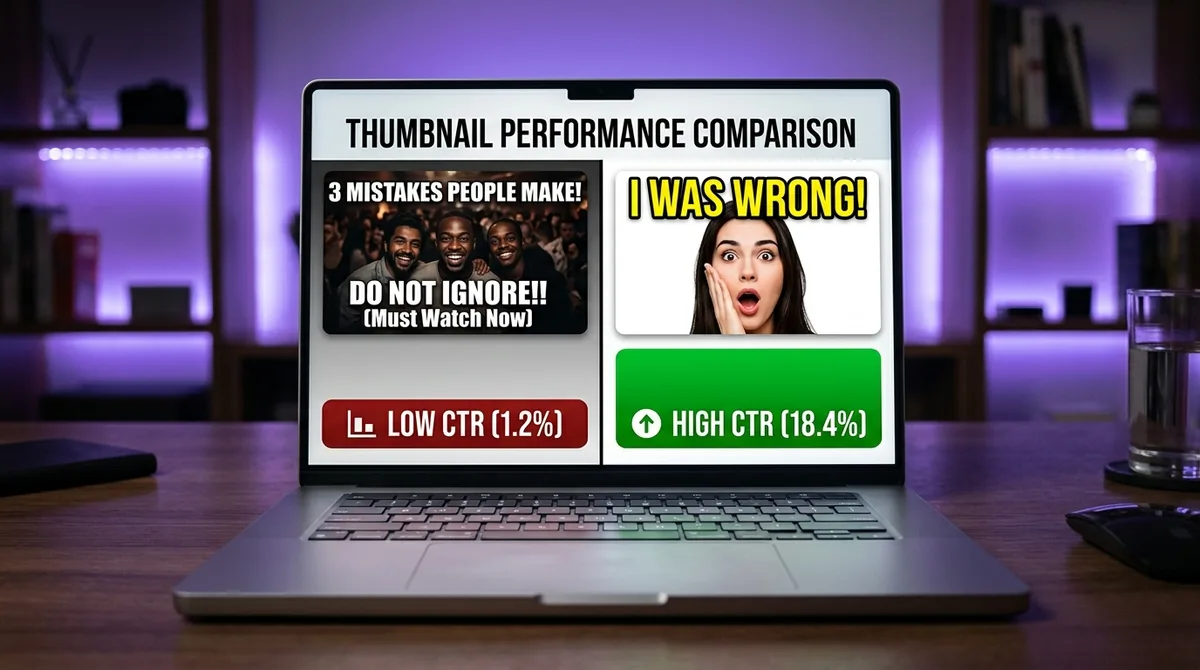
Pairing retention data with CTR (click-through rate) gives you a complete picture of channel health: high CTR with poor retention means your packaging is strong but your content needs work.
Why Audience Retention Is the Metric YouTube Actually Cares About
Most creators obsess over views and subscribers. YouTube's algorithm is watching something else entirely: how long people stay. Audience retention is the percentage of a video that an average viewer watches. A 10-minute video with 60% average retention means the typical viewer watches 6 minutes before leaving. But that single number tells only part of the story.
YouTube uses retention signals to decide whether your video is worth recommending to more people. A video that holds attention gets pushed into Browse, Suggested, and Search placements. A video that bleeds viewers fast gets quietly suppressed. Understanding what the numbers actually mean — not just the average, but the shape of the entire retention curve — is one of the highest-leverage skills a creator can develop.
If you want to understand how retention interacts with your broader channel metrics, 3 YouTube Metrics That Actually Matter (And 2 That Are Just Vanity) lays out the hierarchy clearly.
Reading the Retention Curve: Shape Over Score
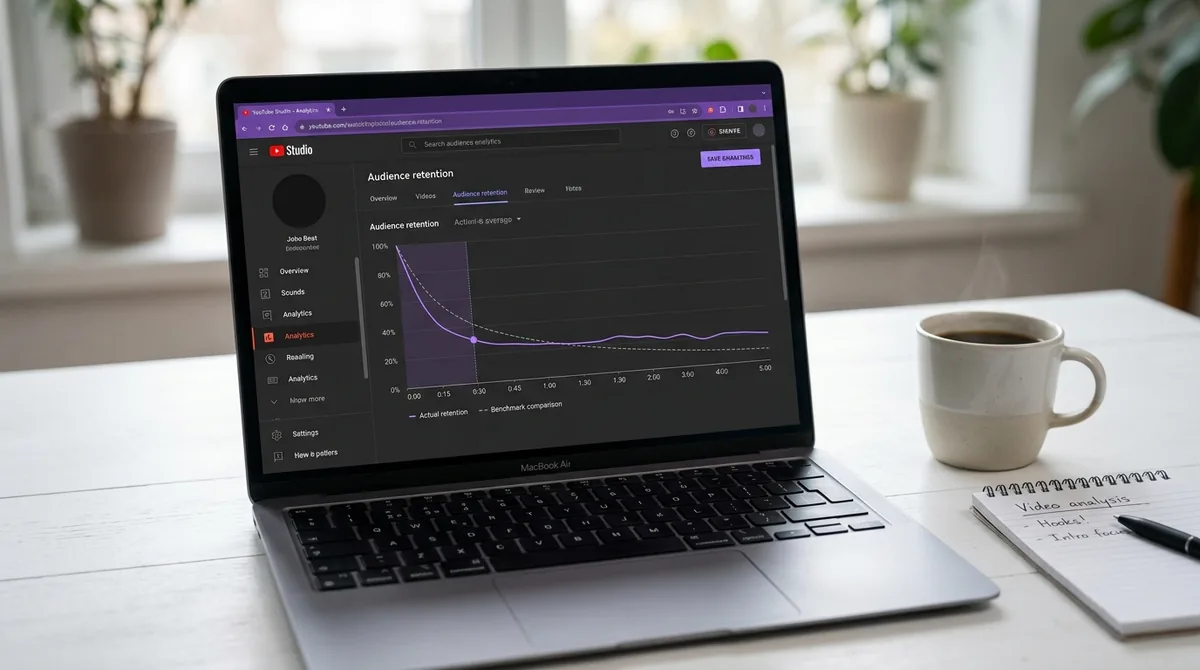
YouTube Studio shows you a line graph — your retention curve — that plots viewer percentage against video timestamp. Most creators glance at the average number and move on. That is the wrong approach. The shape of the curve is where the real information lives.
The Cliff Drop (First 30 Seconds)
A steep drop in the first 15 to 30 seconds is the most dangerous pattern. This is called a cliff drop, and it usually means one of two things: your thumbnail and title attracted the wrong audience, or your opening failed to deliver on the promise that brought viewers in. The hook — the first spoken line or visual sequence — must immediately confirm that the viewer clicked the right video. A cliff drop tells the algorithm that your content is not satisfying viewer intent, which throttles distribution fast.
The Gradual Slope
A slow, steady decline across the video is normal and expected. Viewers leave for hundreds of reasons unrelated to your content quality. What you are looking for is whether your curve declines more steeply than the comparison line YouTube draws — a dashed line representing how similar videos perform. Staying above that line in the first half of your video is a strong positive signal.
Re-Watch Spikes and Flat Plateaus
When the retention line bumps upward, it means viewers are rewinding and re-watching that segment. These spikes are direct audience feedback: something you said, showed, or demonstrated was so valuable or surprising that people played it again. Flat plateaus — where the curve levels off instead of dropping — indicate sustained engagement. Both patterns reveal your strongest content moments.
The Sudden Cliff Mid-Video
A sharp drop at a specific timestamp mid-video usually points to a structural problem: a topic transition that felt jarring, a sponsor read that broke momentum, or a segment that the audience found irrelevant. When you identify these moments, watch your own video at that exact timestamp. You will almost always immediately understand why people left.
Average View Duration vs. Average View Percentage: Know the Difference
Average View Duration (AVD) is the raw time — how many minutes and seconds the average viewer watched. Average View Percentage (AVP) is that duration expressed as a percentage of total video length. A 12-minute video with 4 minutes AVD is 33%. A 3-minute video with 2 minutes AVD is 67%. Both numbers matter, but they matter differently.
YouTube rewards videos that hold a high percentage of viewer time. However, longer videos that sustain even moderate retention percentages generate more total watch time — the raw fuel that powers YouTube's recommendation engine. This is why a 20-minute tutorial with 45% retention often outperforms a 4-minute video with 70% retention in terms of reach, despite the shorter video appearing to be "more efficient."
The key is matching video length to content depth. Padding a topic to reach a longer runtime destroys retention. Cutting a topic short to seem concise wastes the audience's intent. What 90 Days of YouTube Data Actually Reveals About Content Performance shows how tracking these patterns over time exposes the ideal length for your specific niche.
The Hook Rate: Your First 30 Seconds Under the Microscope
Hook rate is the percentage of viewers who click your video and then watch past the 30-second mark. YouTube does not label this metric with that name, but you can calculate it manually: look at the retention percentage at 0:30 on your curve. If 100 people clicked and 62 are still watching at 30 seconds, your hook rate is 62%.
A hook rate below 50% is a red flag. It means more than half the people your thumbnail attracted decided within the first half-minute that the video was not what they expected. Improving your hook rate is one of the fastest ways to improve algorithmic distribution, because YouTube interprets early retention as a signal that your video is accurately satisfying the viewer's search or browse intent.
Hook rate and CTR (click-through rate) — the percentage of people who see your thumbnail and click it — work as a pair. High CTR with a low hook rate means your thumbnail is compelling but your opening does not match its promise. What is YouTube CTR and why does it control your channel's growth? covers the CTR side of this equation in depth.
VSAT: The Viewer Satisfaction Signal Hidden in Your Data
VSAT (Viewer Satisfaction) is not a metric you see directly in YouTube Studio, but it is inferred from a combination of signals: likes, comments, shares, "not interested" reports, and — critically — whether viewers finish your video and then immediately watch another video on your channel. When a viewer finishes your video and clicks on another one of yours, that is one of the strongest satisfaction signals that exists. Your retention curve can help you engineer this outcome by ending videos with a clear, relevant next step rather than a slow, trailing conclusion.
Using Retention Data to Build Better Content, Not Just Better Videos
Retention analysis becomes most powerful when you stop treating each video in isolation and start looking for patterns across your catalog. Which topics hold viewers past the 50% mark most consistently? Which video structures — tutorials, listicles, case studies, narratives — produce the flattest curves? Which thumbnail-to-opening combinations produce the strongest hook rates?
This cross-video pattern recognition is exactly what The 20-30 Video "Data Feedback" Loop: How to Turn Your First Month of Uploads into a Growth Roadmap is designed to help you build. Twenty to thirty videos is enough to identify statistically meaningful patterns in your own retention data — without needing a statistics degree to interpret them.
Tools like AskLibra help surface these cross-video patterns automatically. Based on AskLibra data from 4 connected channels and 511 videos analyzed, longform video content produces an average engagement rate of 0.0226 — more than double the rate for short-form content. This suggests that for channels in the AskLibra network, sustained viewer attention in longer formats is generating stronger engagement signals, not just more watch time. The format you choose directly shapes the retention patterns you will see. Predictive Social Analytics: How to Use Data to See What Your YouTube Channel Needs Before It Happens explores how to move from reactive analysis to proactive content decisions.
What Good Retention Actually Looks Like
There is no universal "good" retention number because benchmarks vary by niche, video length, and audience type. A 40% average view percentage on a 25-minute deep-dive documentary is excellent. A 40% average on a 3-minute explainer is cause for concern. Context is everything.
Instead of chasing a number, chase a shape: a curve that stays above YouTube's comparison line through at least the first half of the video, with no single cliff drop larger than 15 percentage points at any one timestamp. If you can achieve that shape consistently, you are producing content that the algorithm will reward — and more importantly, content that real people are genuinely watching.
For creators who want to understand how the algorithm weighs these signals against each other, Sentiment-Driven Algorithm Shifts: How Viewer Emotion Shapes What YouTube Promotes connects the emotional dimension of viewer behavior to distribution outcomes.
Frequently Asked Questions
What is a good average view percentage on YouTube?
For videos under 5 minutes, aim for 60% or higher. For videos between 10 and 20 minutes, 40 to 55% is strong. For videos over 20 minutes, anything above 35% typically outperforms comparable content. Always compare your number to YouTube's built-in benchmark line for videos of similar length and topic.
Does audience retention directly affect YouTube recommendations?
Yes. YouTube's algorithm uses retention as a core signal to determine whether a video is satisfying viewer intent. Videos that hold viewers longer — especially in the first 30 seconds and relative to similar content — receive preferential placement in Browse, Suggested, and Search results. A consistently strong retention curve is one of the most reliable indicators of a channel that YouTube will push.
What should I do when I find a major drop-off point in my retention curve?
Open your video and watch it starting 15 to 20 seconds before that timestamp. Look for a topic shift, a slow segment, a confusing explanation, or a sponsor read that breaks momentum. Once you identify the cause, apply the fix to future videos — either by restructuring that segment type or by improving your transitions. Do not re-edit past videos unless the content is evergreen and generating significant ongoing traffic.
Is average view duration or average view percentage more important?
Both matter, but they serve different purposes. Average view percentage tells you how efficiently you held attention relative to your video length. Average view duration (in raw minutes) tells you how much total watch time you generated per view. YouTube's recommendation engine weights both, so optimizing for percentage alone — by making very short videos — can actually reduce your overall reach compared to a longer video with slightly lower percentage but much higher total watch time.
How many videos do I need to analyze before retention patterns become meaningful?
Most creators can start identifying reliable patterns after 15 to 20 videos in the same niche and format. Below that threshold, individual video anomalies — an unusual traffic source, a viral share, a slow upload day — can skew your interpretation. At 20 to 30 videos, you have enough data to make format, length, and structural decisions with real confidence.
Ready to see what the data says about your channel?
Stop guessing. Use AskLibra to get a personalized 90-day growth gameplan and find your perfect posting window.
No credit card required • Join 2,000+ creators